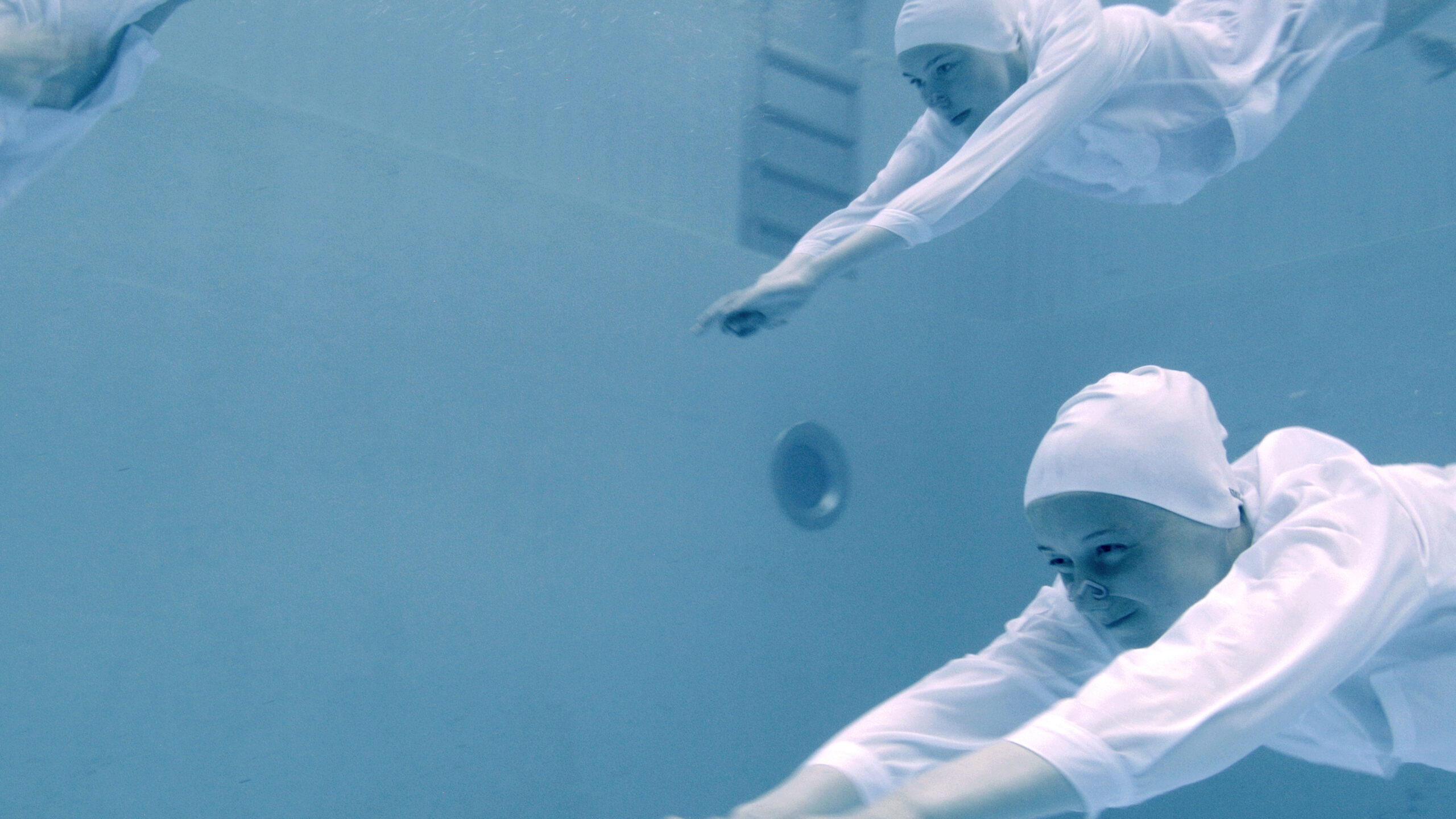
RIVERS IN THE SKY
accessing confluences
Sun 15 November 2026, 1–4:30 p.m.
Performance Day at the Rodenkirchen Riviera and at Temporary Gallery
With performances by Walla Capelobo, Corinna Duschl, Pia Lindman (with Marta Wryk and Sabina Rahn) and Jenni-Juulia Wallinheimo-Heimonen
Practical information
Meeting point: 1 p.m. on the Rhine bank opposite the Kölner Ruderverein von 1877 e.V., Barbarastraße, Köln-Rodenkirchen. The first part takes place outdoors and ends at 2:30 p.m. Please wear warm, waterproof clothes and bring an umbrella.
Part II: Temporary Gallery, Mauritiuswall 35, 50676 Köln, 3:30–4:30 p.m.
As part of the programme accompanying the exhibition untame flow stay release at Temporary Gallery, a series of performances by Walla Capelobo, Corinna Duschl, Pia Lindman and Jenni-Juulia Wallinheimo-Heimonen connects the exhibition with the currents and riverbanks of the Rhine.
Inspired by the cyclical movement of water, these acts allow both sites to converge with stories stemming from North Rhine-Westphalia and Brazil. “Untaming” means loosening the structures that regulate, contain, normalise or marginalise human and more-than-human (water) bodies. From this point of departure, four artistic interventions bring disability justice, climate justice and the rights of nature into conversation.
Disability justice reveals how disabilities are produced through social, political and spatial structures. Climate justice draws attention to the unequal global distribution of the consequences of climate change: states and corporations in the Global North have contributed substantially to the climate crisis through colonial exploitation, industrialisation and the use of fossil fuels, while its effects are felt most acutely in formerly colonised regions of the Global South. The rights of nature movement extends this perspective by calling for ecosystems to be granted their own rights to exist, regenerate and endure, irrespective of their usefulness to humans.
These three movements share a demand for justice for the human and more-than-human bodies most affected by colonial, capitalist and extractivist systems. At what point do the unequal distribution of vulnerability and unequal access to functioning ecosystems become a shared political concern? Which bodies and needs are taken into account, and which are pushed to the margins? Who is granted the right to exist and, with that, access to an environment in which a good life is possible?
PART I: On the banks of the Rhine in Rodenkirchen
1–2:30 p.m.
The day begins on the riverbank. Pia Lindman activates her clay sculpture RiveRhine in collaboration with the river and the singers Marta Wryk and Sabina Rahn. The work draws on the Finnish term manaus: a sung incantation that gathers forces in order to transform reality. The sculpture amplifies the vibrations of the voices and directs them towards the riverbed. Through this sonic exchange, the Rhine emerges as both a counterpart and a resonating body.
With a tea ceremony and snacks, Corinna Duschl traces the Rhine’s history as a trade route connecting coal exports from the Ruhr region and the Rhenish mining district with the wider world. The history of extracting and burning these resources continues to reverberate through climatic changes that become directly perceptible in droughts, low water levels and extreme weather. Duschl’s contribution draws on historical weather rituals documented along the Rhine since the Middle Ages. These pre-Christian practices, performed primarily by women, were intended to bring rain. Their later reinterpretation contributed to the association of women’s knowledge of plants and weather with calamity and witchcraft.
Their snacks are prepared with wintercress, a herb that grows both in landscapes shaped by mining and along the riverbank. In German it is also called Barbarakraut, Saint Barbara’s herb. According to legend, Barbara defied her father and converted to Christianity to escape a forced marriage and preserve her bodily autonomy. Her father imprisoned, tortured and killed her, and was then struck dead by lightning. Through this association with lightning, fire and sudden death, Barbara became the patron saint of miners.
To close the first part, Jenni-Juulia Wallinheimo-Heimonen presents Elephants Remember, a performative artist talk about accessibility and memory. She brings a structure that is at once a kite and a prosthesis into contact with the atmospheric conditions of the riverbank. Her practice exposes how ableist structures restrict bodily autonomy and responds to them with humour, extravagance and self-determined imagination. “Kites with disabilities” suggest that disabled people might be better off flying in a world this inaccessible, but they also ask whether flying is freedom if you are not welcome to land anywhere.
Transition
2:30–3:30 p.m.: together we make our way to the city centre.
PART II: At Temporary Gallery
3:30–4:30 p.m.
Storms and rain carry water through the atmosphere, while lightning makes its elemental forces visible. The Brazilian quilombola thinker Antônio Bispo dos Santos describes these movements as “rivers in the sky”: carriers of histories of exploitation and decolonial resistance that converge and return as part of an enduring planetary cycle.
Walla Capelobo’s intervention opens the second part of the day. It connects the river(s) with the question of mining and brings together elements of North Rhine-Westphalia and Minas Gerais in Brazil, a state so intrinsically tied to mining that it carries the mines in its name. Iron ore has been extracted from the mountains of Minas Gerais for decades.
In a recent investigation, Capelobo found that some mountains near where they were born were left untouched because of rock paintings, which have survived for centuries thanks to iron that oxidises and fixes the images to the rock. Iron is at once an element of destruction and of preservation. Some images consume mountains, as does most of the technology we use to make them, built from mined minerals. Others preserve them. With this in mind, Capelobo presents the lecture performance cave cinema, in which images created by the artist are projected onto a clay screen as a device for storytelling.
We conclude the day with a tea brewed by Corinna Duschl from herbs growing along the Rhine.
Curated by Raphael Daibert, Jussi Koitela, Aneta Rostkowska and Nada Rosa Schroer
Produced by Citra Amongsari
Technical support: Jan Kryszons, Baptist Ohrtmann
Press and public relations: Samanta Lück
Funding and support:
Ministry of Culture and Science of the State North Rhine- Westphalia
Cultural Office of the City of Cologne
Postcode Lottery
Deltax contemporary
Hotel Chelsea
BIOS
Walla Capelobo (b. Brazil, based in Germany) is a dark forest and fertile mud. A multidisciplinary artist, Capelobo experiments with ceramics, installations, videos, texts, workshops and performances. Their work is characterised by time, the flow of physical and/or spiritual energy surrounding the earth through the exchange of minerals, technologies and regenerations. Their practice addresses sensitive issues of existence, supported by Afro-Indigenous South American technologies, speculative ecologies, present-day archaeologies, dreams and delusions.
Capelobo has participated in residencies and exhibitions including Gwangju Biennale, Walk&Talk Biennial (Azoren), Organismo TBA21–Academy (Madrid), South to South: A Meeting on African and Afro-Diasporic Technologies (Brasilien, DR Kongo, Deutschland), AI Anarchies, Akademie der Künste (Berlin), LabVerde (Amazonas), Materia Abierta (Mexiko-Stadt), CACis (Barcelona), Pivô Arte e Pesquisa (São Paulo), und Institute for Postnatural Studies (Madrid).South to South: A Meeting on African ,and Afro-Diasporic Technologies (Brazil, DR Congo, Germany).
Corinna J. Duschl is a media artist whose work focuses on artistic research situated within turbulent ecologies. This gives rise to multimedia installations that often combine ceramic elements, sound and video. Through their practice, they explore the thresholds of folklore, nature and gender narratives. Duschl studied at the Academy of Media Arts Cologne and at Listaháskóli Íslands in Reykjavík.
Pia Lindman is an artist and healer. Following mercury poisoning, she experiences heightened sensitivity of the nervous system and awareness of the micro-signals within her body. She translates these subsensorial signals into visual images, melodies, words and colours and incorporates them into artworks that explore the nuances of different environments and social situations. Pia Lindman works with performance art, healing-as-art, sound, installation, microbes, architecture, painting and sculpture.
In 2024, Lindman participated in the 60th Venice Biennale in the exhibition “The Pleasures We Choose” (Frame / Finnish Pavilion). There, her work Collectivities Cycle took the form of an air-conditioning clay sculpture that exposes visitors to the sculpture’s organic matter and the microbes it supports. It was accompanied by “living digital paintings,” emerging from her ongoing participation in an online Tong Ren healing community, which radiate with images that slowly glitch and shift into different bodily forms and energies.
In Nose, Ears, Eyes (São Paulo Biennial, 2016), Lindman gave subsensorial sessions based on ancient Finnish healing techniques to members of the audience in a mud hut she designed. She then made paintings based on the visions she saw during the sessions.
While Professor of Environmental Art at Aalto University (2013–2018), she was director of Biofilia – Base for Biological Art. At the Massachusetts Institute of Technology (MIT), she collaborated with researchers in Humanoid Robotics at the Computer Science and Artificial Intelligence Laboratory (2004–2007).
Recent exhibitions include Chewing the Tundra at Kunsthalle Exnergasse, Vienna, Austria (2022, co-curated by Lindman/Gretarsdottir) and Not Without My Ghosts, Hayward Gallery Touring, UK (2019–2022). In 2025, Lindman was commissioned to create H2OMANAUS, a collective performance and public sculpture for the European Capital of Culture Trenčín, Slovakia, 2026. Lindman is currently showing Mude Muta, a public sculpture for storytelling, and an animation for “Haunted by Waters,” produced by IntoNature in the Netherlands.
The result of many years of investigation into the human body and its place within political and cultural spaces, Lindman’s work has evolved to encompass multiple co-created realms of organic and inorganic life.
Jenni-Juulia Wallinheimo-Heimonen (b. 1974) is an Artist Professor in Multidisciplinary Art (2025–2029) and a disability activist. In 2024 she was one of three artists representing Finland at the Venice Biennale. In 2019 she received the Finnish State Prize for Multidisciplinary Art. In 2018 her short film about care robotics won Best Screenplay at the Pisa Robotic Film Festival. In 2026 she took part in the E75 Art Bus tour from the Mediterranean to the Arctic Ocean as part of Oulu European Capital of Culture. From June 2026 to January 2027, her short film How Great is Your Darkness? is on view at the Design Museum of Chicago.
Wallinheimo-Heimonen’s work spans sculpture, installation, film, performance and activism within disability politics and policy. In 2022 she was artist in residence at Harbourfront Centre Toronto as part of the Nordic Bridges programme and participated in the 8th Biennial of Contemporary Art Fundación ONCE in Madrid. She holds a BA from Aalto University School of Arts, Design and Architecture in Helsinki. She has osteogenesis imperfecta as a piquant characteristic.
Marta Wryk is a Polish mezzo-soprano based in Bielefeld. She studied at the Fryderyk Chopin University of Music in Warsaw and at the Manhattan School of Music in New York. After her US debut in Philip Glass’s Orphée at Virginia Opera, she came to European attention when she stepped in as Smeton in Anna Bolena at Oper Köln, where she later became an ensemble member.
She has appeared at Oper Bonn, Staatsoper Hannover, Hessisches Staatstheater Wiesbaden, Concertgebouw Amsterdam, Kölner Philharmonie, Philharmonie Luxembourg, Tonhalle Düsseldorf and Symphony Space New York. Currently an ensemble member at Theater Bielefeld, Marta is also active as an educator and author. Alongside her operatic career, she develops independent artistic projects at the intersection of music, feminism and interdisciplinary practice. She has a particular passion for contemporary music and for exploring new artistic perspectives.
Sabina Rahn (formerly Sabina Krauze) is a singer and musician performing on music and theatre stages. She completed first-level music school and continued her artistic education with private teachers and through various workshops. In 2017 she graduated from Jagiellonian University in Kraków with a degree in Cognitive Science, with a particular interest in neuroaesthetics and a master’s thesis focused on the psychology of music. In 2019–2020, she studied at the Gardzienice Academy of Theatre Practices. Her artistic work focuses on traditional, theatrical and improvised music. She is also fascinated by rites of passage in traditional cultures and by the various roles music plays in society.
Bild / Image:
Jenni-Juulia Wallinheimo-Heimonen, How Great is Your Darkness?, 2024, film still, author Cristal Alakoski.
Quelle / Source: Antônio Bispo dos Santos, „Somos da terra“, Piseagrama, 2018.