On Alternative Ways of Living and Housing
Finissage of Nie Pastille's Exhibition
With Lucia Halder, Tom Hunter, Nie Pastille, Philip Soonti, and Stefan Wartenberg
With a presentation of the zine featuring the exhibition text by Aneta Rostkowska and poems by Stefan Wartenberg
Moderation: Aneta Rostkowska
Food by: AMA.TWI
Sunday, 9 August 2026
3–6 pm
Language: English
We warmly invite you to the finissage of the exhibition ins Himmelszelt es leuchtet leuchtend rot – an afternoon of conversation, storytelling, and shared food, all centred on alternative ways of living and housing.
At a time of scarce and increasingly expensive housing, the question of other ways of living and being together feels more urgent than ever: forms such as the wagon settlement (Bauwagenplatz), the squat, or the tiny house have existed for a long time and challenge established notions of home and property – yet it is precisely these forms that are increasingly under pressure and being displaced. The afternoon approaches this theme from a range of different perspectives, while also opening space for broader questions around art, craft, and collaboration.
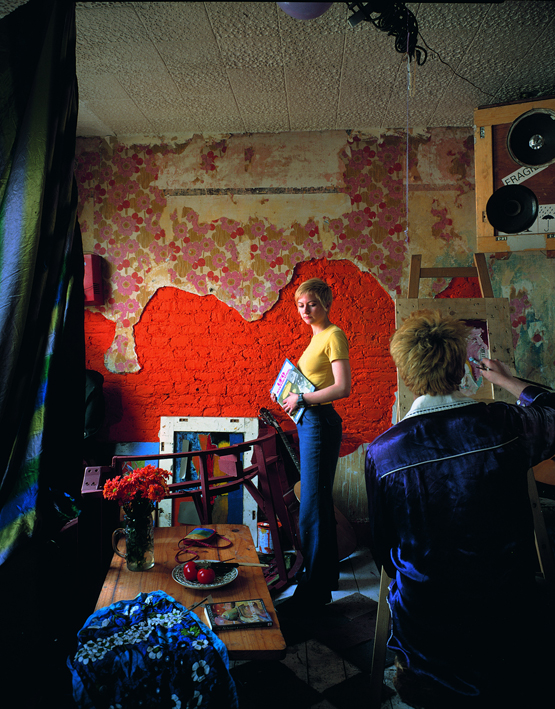
The afternoon opens with a conversation between Lucia Halder and photographer Tom Hunter, whose works from the series Travellers and Persons Unknown are shown in the exhibition alongside those of Nie Pastille. For Travellers (1996–1998), Hunter travelled through England and Europe himself in a double-decker bus, photographing the lives of his friends and fellow travellers – his images explore the aesthetics of the wagon as a living space and, through art-historical references, lend dignity to marginalised ways of life. The photographs in Persons Unknown (1997) were taken on his own street in Hackney, where he and his neighbours were fighting eviction as squatters – the title comes from the wording used in their eviction orders, and the postures and gestures of those portrayed reference paintings by Johannes Vermeer. From these works, the conversation opens onto broader questions: living between freedom, the provisional, resistance, and threat; photography as a political tool; the relationship between documentary experience and art-historical staging; and what has changed since the 1990s.
Afterwards, Nie Pastille will speak about her life at a wagon settlement in Cologne and how it shapes her artistic practice. Philip Soonti, who helped Nie learn to weave in Ghana, will talk about his work with the Nubuke Foundation – in particular the festival dedicated to weaving. The afternoon closes with Stefan Wartenberg, who will read poems written in response to Nie Pastille’s work and speak about his collaborations with other artists. Food will be prepared by AMA.TWI.
We look forward to seeing you there!
Biographies
Lucia Halder has been a curator and scientific researcher for the photographic collection at the Rautenstrauch-Joest-Museum since 2015 and chair of the History & Archives section of the German Society for Photography (DGPh). Her work examines the history, semantics, and politics of memory embedded in historical and contemporary photographs. She is also a team member of Photoszene Köln, where she focuses on exploring decolonial spaces of action within photographic archives and collections. Halder studied Modern and Contemporary History and Art History in Konstanz, Tübingen, and Berlin. From 2012 to 2016, she was a research associate at the Georg Eckert Institute in Braunschweig on the project “Visual History: Institutions and Media of Pictorial Memory,” where her doctoral research focused on iconographies of socialism in schoolbooks. She previously worked as an exhibition curator, including at the Haus der Geschichte der Bundesrepublik Deutschland, where she contributed to the exhibition “Bilder im Kopf. Ikonen der Zeitgeschichte” (2009).
Tom Hunter is an artist working with photography and film, living and based in East London. He is an Honorary Fellow of the Royal Photographic Society and holds an Honorary Doctorate from the University of East London, alongside numerous career awards including the Rose Award for Photography at the Royal Academy, London, and the Photographic Portrait Prize at the National Portrait Gallery, London. He graduated from the London College of Printing in 1994 and went on to complete his MA at the Royal College of Art, where he received the 1996 Fuji Film Photography Prize for his series Travellers. In 1998, Woman Reading a Possession Order, from his series Persons Unknown, won the Photographic Portrait Award at the National Portrait Gallery.
His work has been shown nationally and internationally in major solo and group exhibitions, including Life and Death in Hackney at the National Gallery of Art, Washington D.C.; Seduced by Art at the National Gallery, London; A Palace for Us at the Serpentine Gallery, London; and Another Story: Photography from the Moderna Museet, Stockholm. He has published eight books, among them Down The Lane (Café Royal Books, 2020), Where Have All The Flowers Gone (Hartmann Projects, 2019), Le Crowbar (Here Press, 2013), and The Way Home (Hatje Cantz, 2012). Hunter has been commissioned by the Serpentine Gallery, the Victoria and Albert Museum, the Museum of London, and the Royal Shakespeare Company, and his work is held in major collections including MoMA, New York; the V&A and Tate Modern, London; the Moderna Museet, Stockholm; the Smithsonian and National Gallery of Art, Washington D.C.; and the Los Angeles County Museum of Art.
Nie Pastille, born in Duisburg in 1966, studied Fine Art at the Hogeschool voor de Kunsten in Arnhem and at the Sandberg Instituut in Amsterdam. She had previously studied Social Sciences at the Gerhard Mercator University in Duisburg. She lives and works in Cologne. Selected exhibitions: Blue Binding Ribbon (Temporary Gallery, Cologne, 2024), Mango Jellyfish Action (Cosima Pilz, Munich, 2024), WIE OOB (Hidde von Seggelen, Hamburg, 2021), 1919 49 69ff. Aufbrüche (Kolumba Museum, Cologne, 2019), Tanz lang (Cabinet of Caput, Cologne, 2016), Köln um halb acht (Temporary Gallery, Cologne, 2014 & 2019), No Bodies Meta (Galerie Sebastian Brandl, Cologne, 2013), Anweisung (Galerie Charlotte Desaga, Cologne, 2010), Pressgang (Reinier van Ewijk Projects, Amsterdam, 2008), and The Contented Heart (W139, Amsterdam, 2007). Residencies abroad: Bawku, Ghana, 2022 & 2023.
Philip Soonti is a Ghanaian cultural practitioner working in community engagement, cultural programming, and the preservation of traditional textile heritage in Ghana’s Upper West Region. Since 2022, he has been a core member of the team at the Nubuke Centre for Textiles and Clay in Loho, near Wa – a satellite of the Nubuke Foundation, the Accra-based arts institution founded in 2006. There, he helped establish the Centre’s public programme from the outset, supporting the 2022 edition of the Woori Festival, Ghana’s only festival dedicated to weaving, and leading community mobilisation efforts that grew festival attendance from roughly 300 participants in 2022 to more than 1,500 by 2024. Since 2022, Soonti has also coordinated the Centre’s children’s workshop programme, facilitating more than 100 workshops with artists, weavers, and cultural practitioners, and has guided visiting artists, researchers, and institutional partners through the Centre’s exhibitions and collections.
Stefan Wartenberg, born in Rostock in 1981, studied Fine Art at the Academy of Visual Arts Leipzig and is a co-founder of the artist group Graffitimuseum. As an artist, he enjoys working site-specifically, through installation and performance. Above all, however, he writes poetry, published among others by Possible Books, AKV-Berlin, and Lubok. In 2021, Wartenberg founded Nachtalb Verlag Engelsdorf, a publishing house dedicated to poetry and related literary genres that supports young authors.
Images
1 – Tom Hunter, Woman Reading a Possession Order, from the series Persons Unknown, 1997
2 – Tom Hunter, The Art of Squatting, 1997