Shapes without edges. An Evening of Films with Molly Palmer and Daniel Kothenschulte
Thursday, 30.07.2026, 7 p.m.
Filmpalette Köln, Lübecker Str. 15, 50668 Köln
Free entrance
Language: English
As part of the exhibition by Nie Pastille at Temporary Gallery, Filmpalette presents several works by artist Molly Palmer: the film Amulet (2024). And the three-part installation Some Shapes Without Edges (2016). Following the screening, Molly Palmer will be in conversation with film critic Daniel Kothenschulte.
As part of the exhibition by Nie Pastille at Temporary Gallery, Filmpalette presents several works by artist Molly Palmer: the film Amulet (2024) and video works from the three-part installation Some Shapes Without Edges (2016). Following the screening, Molly Palmer will be in conversation with film critic Daniel Kothenschulte.
About the works
Amulet (38 min) follows a group of people who have worked together with artist Molly Palmer over a period of years. The group is brought together by shared histories of experiencing the world differently than usual - for example through grief, anxiety, depression or psychosis. The film does not treat these different ways of perceiving as a problem, but as something that can show us dimensions of everyday life that we habitually tune out. Together, the group looks for patterns and signs in their surroundings. The film takes place in two very different buildings: Buitenplaats Doornburgh, a former convent in the Netherlands, and Het HEM, a former bullet factory in Zaandam. Both buildings carry traces of older rules, order and control. The convent was built following strict architectural principles meant to create calm - but the participants ask who such spaces were really designed for, and who they leave out by valuing ideas of order over disorder. The former factory is organised to optimise labour, performance and control. The group uses the space in a new way instead: as a place to share experiences that usually have little room in a society focused on productivity. In both buildings, the group develops its own shared language of movement and simple objects like mirrors and flashlights. Even the camera becomes part of the experience - a flash of light or a shadow can suddenly become an important sign that the group interprets together. Amulet questions the embeddedness of ideals like sense, rationality and reason in our culture and architecture, asking if altered experiences of time and reality can help decenter normative ideologies and establish new rhythms of awareness contributing to change.
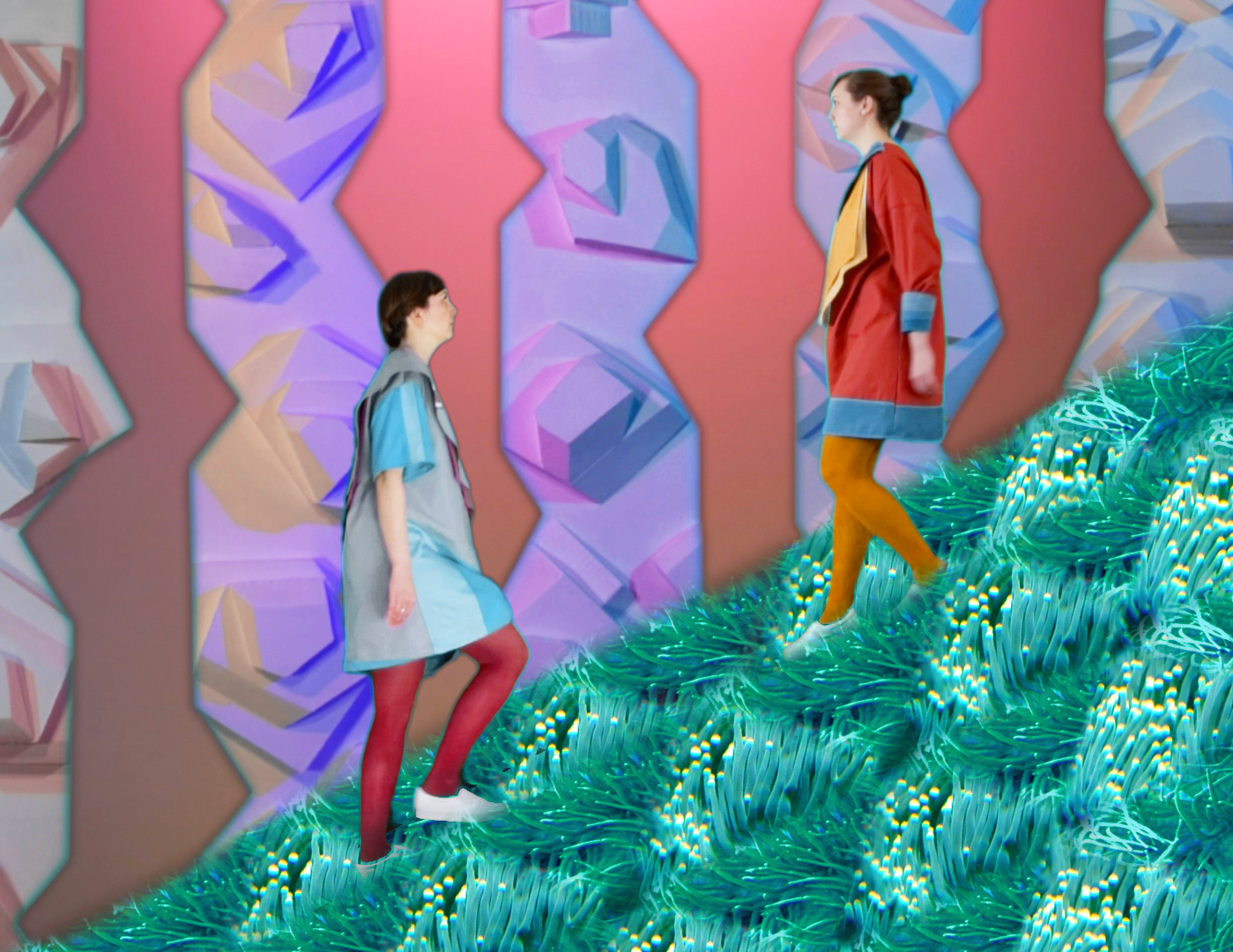
Some Shapes Without Edges is a set of three short films about being human - with all its mystery, contradictions and moments of absurdity. The films were first shown inside a wooden stage set built especially for them, with surround sound and a synchronised lighting scenography that pulled viewers right into the films' world.
The longest video work, Two Friends and Two Curtains (7:45 min.), was made with participants grieving recent loss through suicide. Its title comes from a David Hockney print of two heads at a window, which appeared in a book being read to a friend during a breakdown after her father’s death. The image became symbolic of the simple power of solidarity and companionship. In the film, the heads become statues. Two twins try to teach them what friendship means, but the word becomes abstract and strange. Sign language and choreography explore feelings that hover below language, the anxieties and contradictions of emotional connection - how it is both fleeting and enduring, especially after loss.
Heart Song (2:13 min.) brings to mind the short film clips that used to play before old Hollywood movies. Its images come from a strange real experience the artist had: through her camera, she saw a woman standing on a pier who then suddenly seemed to vanish, though this shouldn't have been possible. The film plays with what we can and cannot see, and asks questions about how we perceive the world around us.
Apples (1:58 min.) is a short, simple, and slightly mysterious film. A narrator watches people who walk backwards up a hill for exercise. When they pass someone walking forwards up the same hill, an awkward moment happens - both try to look calm, gazing sideways as if admiring the view, while the pretence produces a strange abstract experience of the scene.
About the artist
Molly Palmer was Artist in Residence at the Rijksakademie van Beeldende Kunsten in Amsterdam, where she exhibited at the Open in 2021 and prepared solo shows for 1646 in The Hague and Ty Pawb in Wales. She graduated from the Royal Academy Schools in 2016, where she was awarded the Gold Medal. She received Arts Council England's Creative Practice Development Fund and has exhibited widely at galleries and museums, including Nest, The Hague (2023); Buitenplaats Doornburgh, Maarssen, NL (2023); AKINCI, Amsterdam (2024, 2022, 2021); Dastan Basement, Tehran (2021); 1946, The Hague (2019); TENT, Rotterdam (2019); Somerset House, London (2018); House of Egorn, Berlin (2018); Art Basel Miami Beach (2016); Bikini Wax & MUPO, Mexico (2016); Galeria Vermelho, São Paulo (2016); and Glasgow Project Room (2018). Palmer lives and works between Amsterdam and London.
About Daniel Kothenschulte
Daniel Kothenschulte, born and raised in Cologne, studied art history, theatre, film and television studies, and German literature there and in Bochum. For many years he has written as a film critic for the Frankfurter Rundschau on film history, photography, art and pop culture - with a particular passion for animation and the work of Walt Disney, to whom he has dedicated numerous publications, including the co-edited standard reference The Walt Disney Film Archives. Alongside his journalistic work, Kothenschulte curates film programmes for institutions such as the Museum Ludwig and the KunstFilmBiennale; in 2013 he initiated the series Videonale Scope, in which he has presented international film and media artists such as Kenneth Anger, James Benning and Birgit Hein in workshop conversations in Cologne. He has taught at the Städelschule in Frankfurt and is currently a lecturer at the University of Television and Film Munich. Daniel Kothenschulte lives in Cologne, where he also maintains an extensive collection of classic Hollywood glamour photography.