ins Himmelszelt es leuchtet leuchtend rot*
Exhibition by Nie Pastille (with Tom Hunter, Ewa Kuryluk and Molly Palmer)
4 May – 9 August 2026
Opening: Sun 3 May, 11a.m.-5p.m.
with brunch by AMA.TWI and children's activities
Curator: Aneta Rostkowska
Exhibition design: Mateusz Okoński
In her book Vibrant Matter (2010), the American philosopher and political scientist Jane Bennett argues against the notion of matter as dead, passive stuff waiting to be given form and meaning by human intention. She writes that matter is alive and possesses its own capacity to act. Objects do not act like humans, but neither are they mere tools that fulfil a function. Somewhere in between, they form a force that affects, resists, surprises – and co-creates.
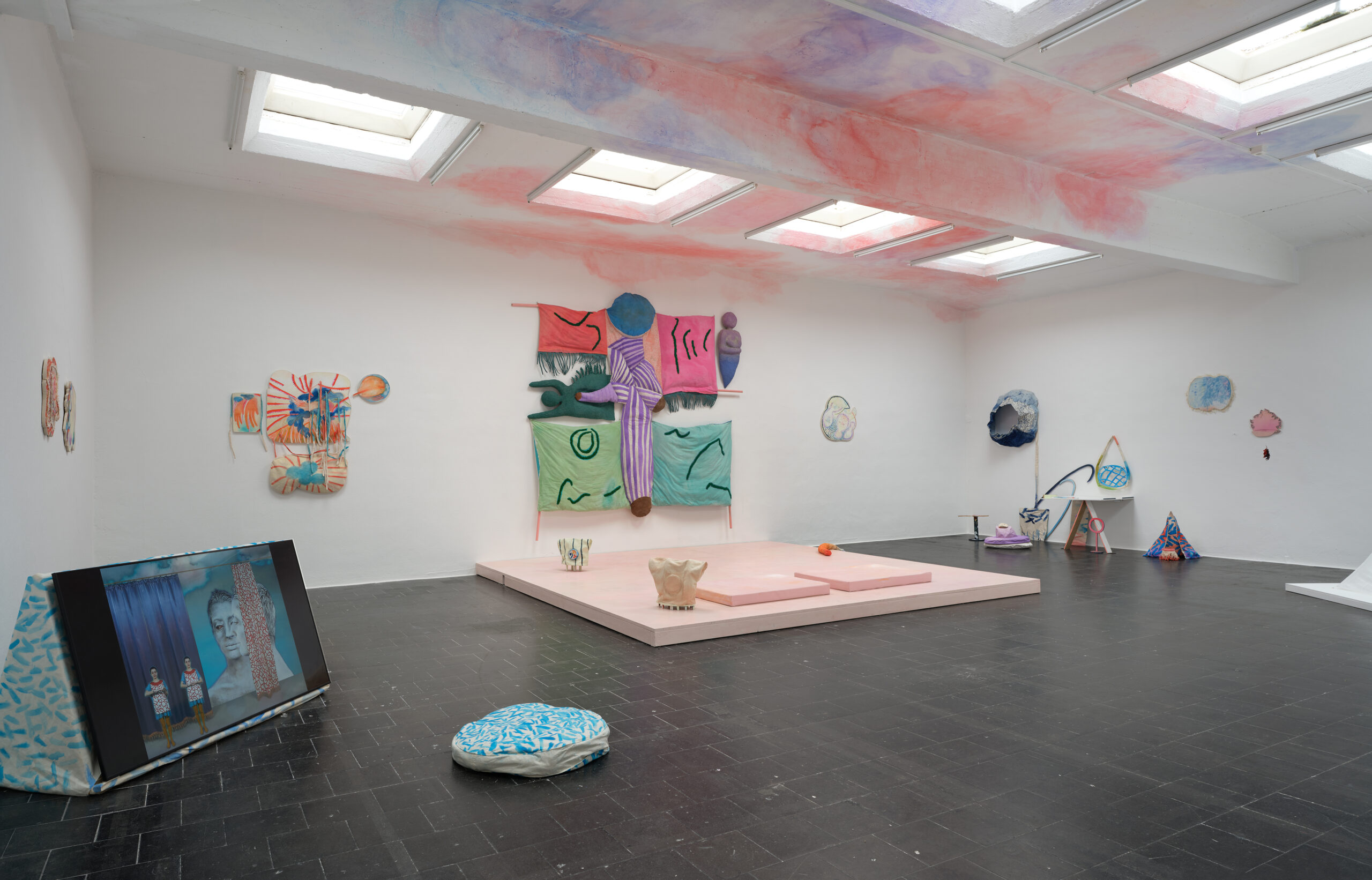
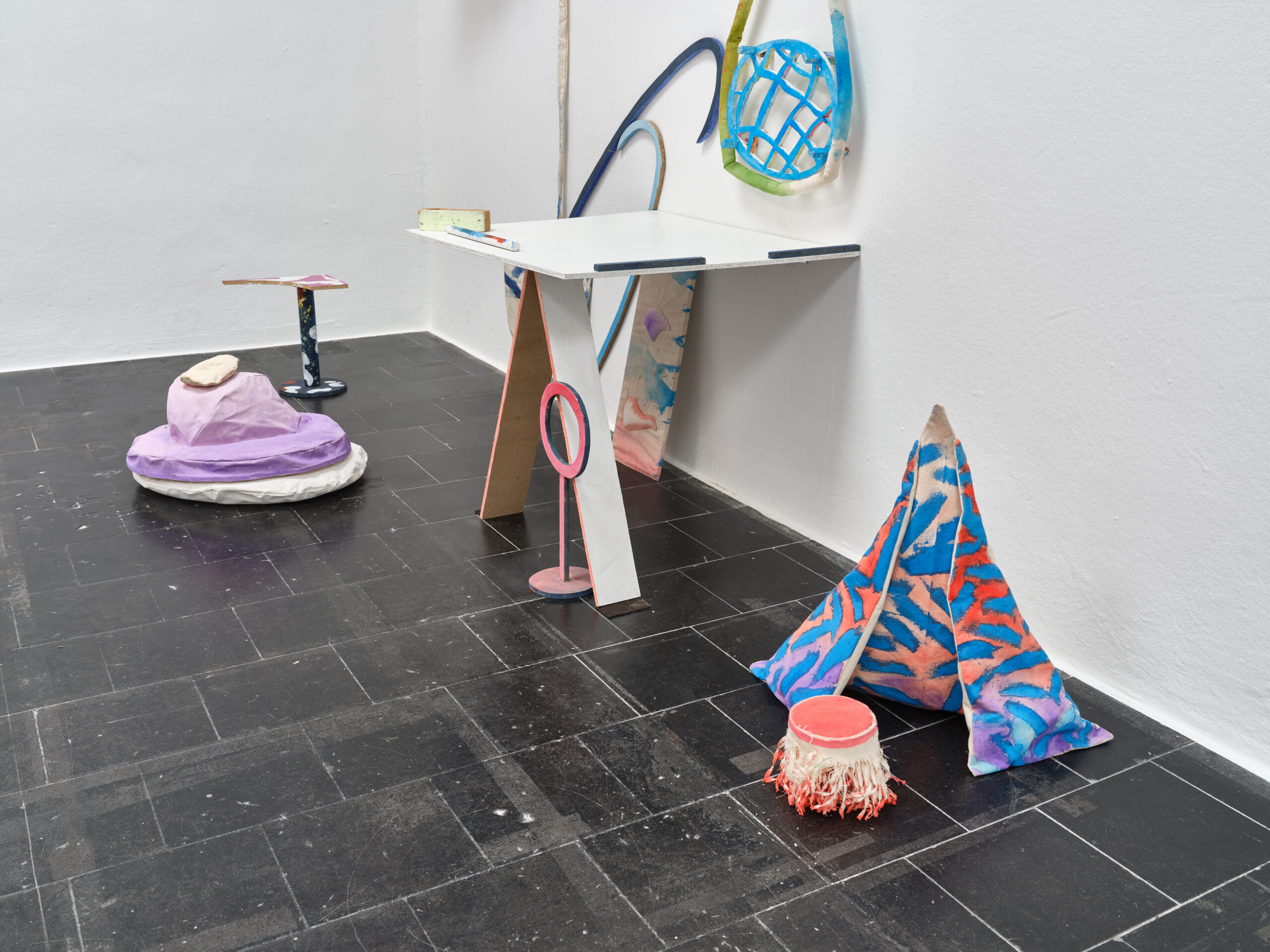
In the art of Nie Pastille, this force is both felt and seen. Her objects do not follow the fixed paths of a single medium, but bring together the most diverse materials: wood, wool, canvas, fabrics, pigments, leaves and branches. There are irregular forms that know no rectangular frame. Fabrics that are simultaneously painted and sewn, that bulge and hang. Plywood cut like a body, not like a picture. Colours that do not decorate but press. The works seem like beings that have drawn air into their lungs, broken out of their frames and are now roaming through the gallery space. Each work exists on its own, yet together they form a mysterious, anarchic community. The work seems to be the result of a negotiation between artist and material – and the material has had its say, or rather: one has followed it.
But what does it mean to follow a material? It means not deciding before one has touched. Not knowing before one has felt. It means giving the object one's full attention and, in a sense, paradoxically giving it space. In a certain way, we are dealing here with a particular attitude: sensitivity to the properties of materials, a patient care that guides the process and holds fragments together, the power of the meditative repetition of gestures – weaving, sewing, filling – until the form emerges; careful gathering of remnants and attentive preservation. Things are taken seriously in their liveliness and not treated as dead stuff to be shaped. The works often form a compelling mixture of fragility and obstinacy. They oscillate between order and dissolution, lightness and weight, intimacy and distance, openness and resistance.
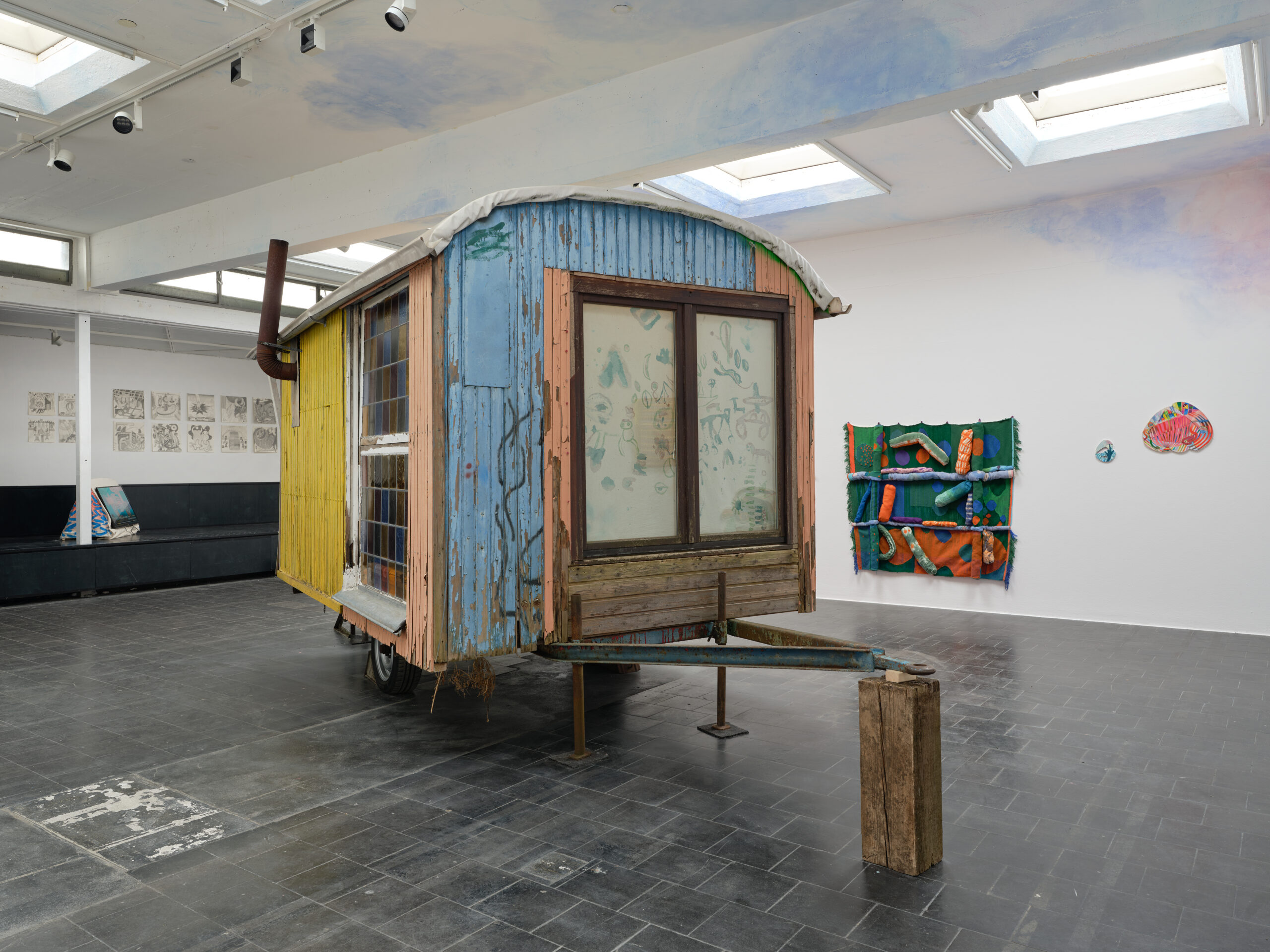
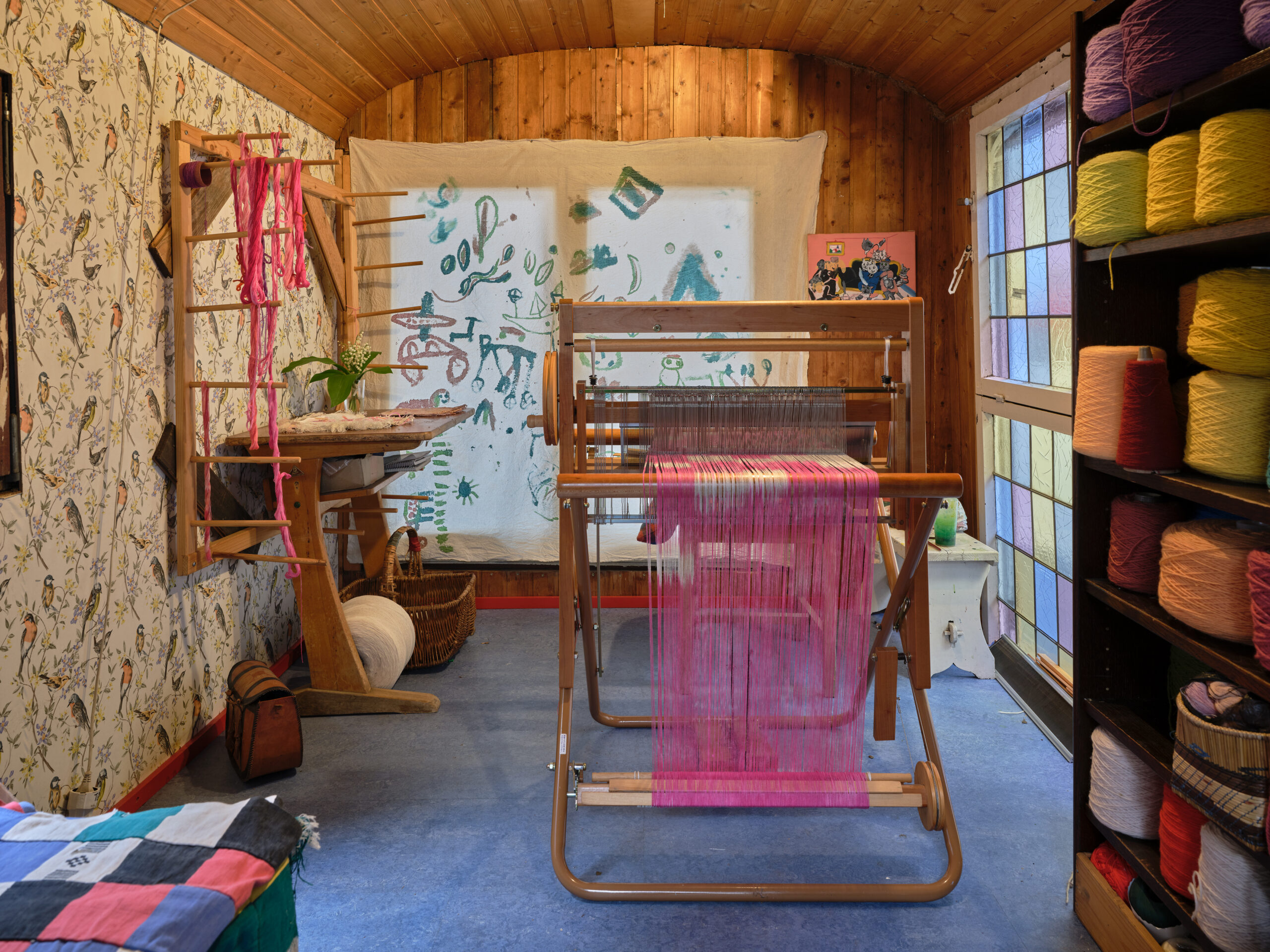
To better illuminate this attitude, for Nie Pastille's first institutional solo exhibition we are bringing her actual workplace into the exhibition space: a construction trailer with a loom. This trailer normally stands at the trailer park Wem gehört die Welt (Who owns the world) in Cologne, where Nie Pastille also lives in another trailer. In the exhibition it functions simultaneously as architecture, exhibition space, sculpture and functional workspace. A construction trailer and a trailer park (or rather a specific German form of it - Bauwagenplatz) represent a very specific way of living. It is a conscious positioning outside conventional domestic and social structures, often associated with autonomy, alternative and frequently anti-capitalist community, ecological awareness and the rejection of bourgeois stability. On one hand, it is quite practically a life lived in a small, bounded, mobile container – a very defined personal space. On the other hand, one has a large outdoor area and the connection to the outside is very strong. The trailer park in Cologne sits in the middle of the city and serves not only as a place of residence but also as an event venue with a bar, concerts and more. This life also has a specific aesthetic: it is not immaculate, it bears the traces of time, and much is self-built. Through a wooden platform in the second room – one that resembles a platform in another of the artist's workspaces – the exhibition gains a new dimension: it becomes a large, open studio in which artistic process and presentation flow into one another. It is a place of observation, encounter and collaboration. During the exhibition, the artist will work on an installation that changes and transforms throughout the entire run. She will also offer a weaving workshop for the public. Just as Pastille's works suggest a movement, an unfolding potentiality, the exhibition itself will develop over time and take on other forms.
In a certain sense, the trailer here is not only a place of living and working, but also an agent. It has partly shaped Pastille's practice: her slowness, her intimacy with material, her willingness to trust the provisional. When it is now placed in the exhibition space, it brings this history with it – not as a narrative, but as a force. In the exhibition, Bennett's theory meets another compelling line of thought that proves fruitful for understanding Pastille's work: the concept of the "theoretical object." This concept appears in different formulations in the work of art historians such as Hubert Damisch, Georges Didi-Huberman and Mieke Bal. A theoretical object is not a work that illustrates an already formulated idea. A theoretical object thinks for itself. It poses questions that can only be asked in the form of the object itself – questions that elude language as long as one does not stand directly before it. The theory of the theoretical object is an attempt to elevate artistic practice in relation to theoretical discourse and to grasp it as its own form of reflection. Art is taken seriously here in its epistemic efficacy. The works of Nie Pastille have something rebellious about them in this regard. They do not lend themselves to easy classification or inscription into popular discourses about contemporary art. The artist's material approach and her way of life – the two belong together – generate their own questions:
What does shelter mean when home stands on wheels? What does care mean when everything is provisional? What does it mean to truly practise artistic autonomy? How far does one want to go, and how much comfort is one prepared to give up? And if objects have their own agency – how does one let them unfold it?
An important place in the exhibition is held by the artist's drawings. They form a serious and deeply personal body of work with a fully developed internal language. The consistent square format, the exclusive use of graphite and a shared symbolic vocabulary show that these are not isolated experiments but an ongoing, sustained practice. The drawings reward close looking: details that initially appear decorative reveal themselves on closer inspection to be narrative or symbolic. The tension between control – precise patterning, architectural geometry – and dissolution – scribbled tangles, transforming bodies – gives the works considerable energy. They seem pervaded by the experience of being subject to forces – natural, psychological, systemic or cosmic – that exceed human scale. There is a persistent tension between containment and escape, between organic life and rigid structure, between the mythological and the mundane. Traffic lights and flags appear alongside descending celestial figures; molecular diagrams coexist with tentacled sea creatures. This collision of different registers – the bureaucratic and the archaic, the microscopic and the monumental – gives the works a quality of anxious simultaneity. It is as though the artist is attempting to map an overwhelming inner and outer world onto the same flat surface, holding all of it in view at once. They allow for different interpretations. Containers and vessels – cylinders, bowls, boxes and cages – may here be not only symbols of entrapment but also of habitation, of the small, bounded space that simultaneously offers shelter and constraint. The tension between inside and outside that runs through so many of the compositions – figures peering into boxes, beings emerging from vessels, bodies half-contained and half-escaping – could reflect the everyday experience of a very particular relationship to interior and exterior space.
Three international guests enter into dialogue with this practice in the exhibition. The Polish artist, art historian and writer Ewa Kuryluk is a pioneer of ephemeral textile installation. Her Namiot (Tent, 1980), whose wings are formed by two acrylic paintings on Chinese silk, was first shown as part of the larger installation Podróż (Journey). Throughout her series of paintings on silk, she references the iconographic representation of the veil of Saint Veronica and the associated idea of the ephemeral trace – the imprint of a suffering human body on the shroud that covers it. She also dedicated a book to this idea: Veronica and Her Cloth (1998). Her works turn, however, away from Christian symbolism and towards the recording of individual emotions, a fascination with life, and with love and sexuality.
Tom Hunter photographed his series Travellers (1996–1998) while travelling himself through England and Europe in a double-decker bus. In these portraits he documented the lives of his friends and fellow travellers. His work explores the aesthetics of the wagon as a living space and lends dignity to marginalised ways of life through art-historical references. The photographs of the series Persons Unknown (1997) were taken in his street in Hackney, where he and other residents were fighting eviction as squatters – the title of the series comes from the wording used in their eviction orders. Here, the postures and gestures of those portrayed reference paintings by Johannes Vermeer.
Molly Palmer presents two video works: Two Friends and Two Curtains (2006) and In Addition to Everything Real (2015). Using handmade props, sets and costumes, she places her protagonists via greenscreen into layered video worlds in which music, gesture and dialogue tell stories in their own peculiar way. In the first work, two statues learn from a pair of curtains what friendship means. The second one begins as a story about two lifts in a building. Their predictable, routine choreography, however, reveals hidden parallel worlds, unfolding a captivating fantasy.
Aneta Rostkowska
-
Nie Pastille, born 1966 in Duisburg, studied Fine Art at the Hogeschool voor de Kunsten in Arnhem and at the Sandberg Instituut in Amsterdam. She had previously studied Social Sciences at the Gerhard Mercator University in Duisburg. She lives and works in Cologne. Selected exhibitions: Blue Binding Ribbon (Temporary Gallery, Cologne, 2024), Mango Jellyfish Action (Cosima Pilz, Munich, 2024), WIE OOB (Hidde von Seggelen, Hamburg, 2021), 1919 49 69ff. Aufbrüche (Kolumba Museum, Cologne, 2019), Tanz lang (Cabinet of Caput, Cologne, 2016), Köln um halb acht (Temporary Gallery, Cologne, 2014 & 2019), No Bodies Meta (Galerie Sebastian Brandl, Cologne, 2013), Anweisung (Galerie Charlotte Desaga, Cologne, 2010), Pressgang (Reinier van Ewijk Projects, Amsterdam, 2008) and The Contented Heart (W139, Amsterdam, 2007). Residencies abroad: Bawku, Ghana, 2022 & 2023.
*The title of the exhibition is taken from the poem "Fürsorge" (Care) by Stefan Wartenberg, which was inspired by the work of Nie Pastille.
Care
Window open
Goldfish in
the cloud-bird lays a raw egg
into the sky-tent it glows glowing red
into our room at the campsite
next to the cloakroom
and that it rains as if from jellyfish
and that the sun shines at the same time
and everything dries again
as if before the moisture
can seep inside is due to the season
and leads us to water the tree
personally three times a day
Photos: Simon Vogel