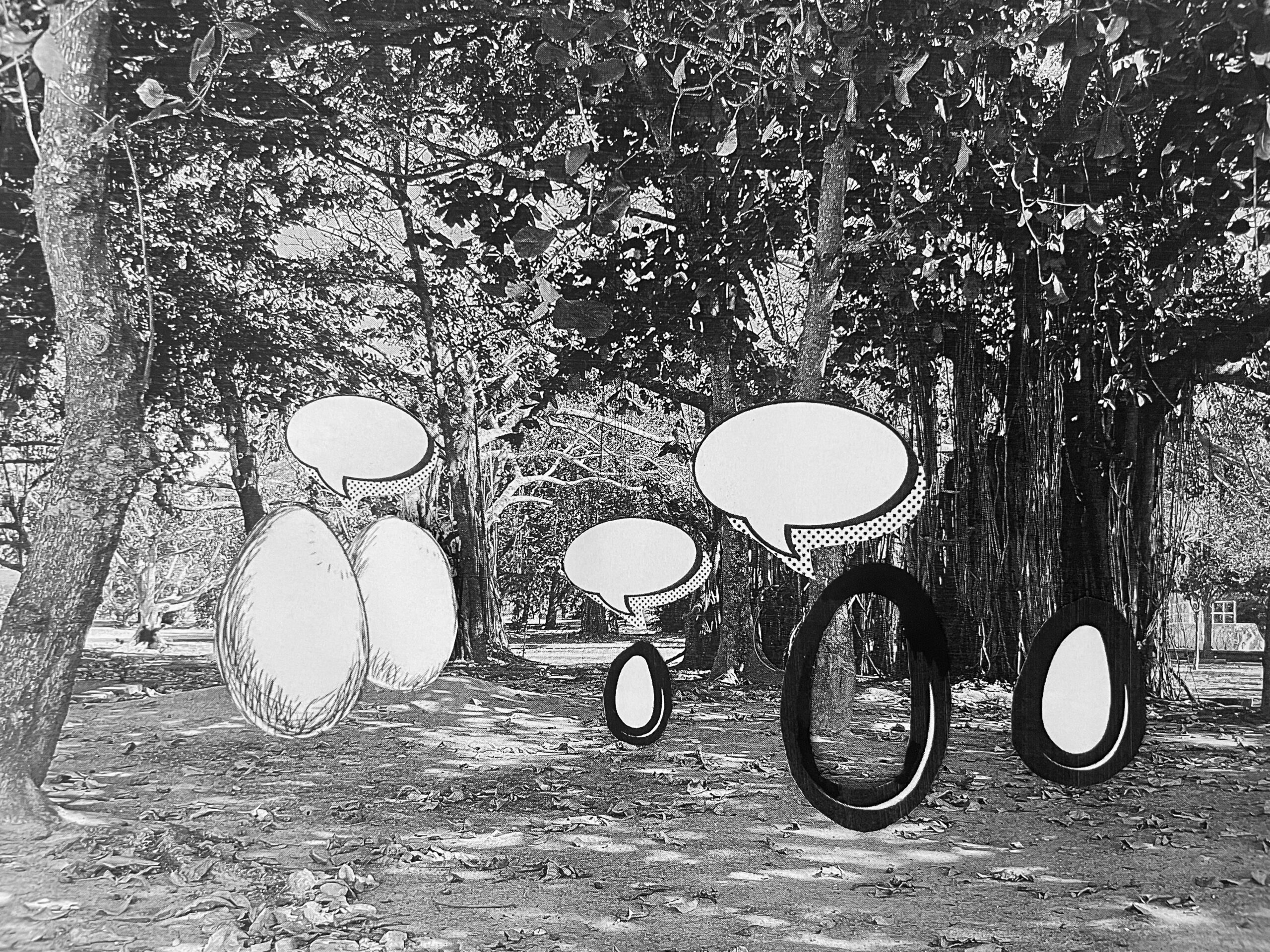
SYMPOSIUM: SPECULATIVE PEN — Fabulating Institutional Futures
From 9 to 11 July, together with Kunstverein Siegen and Kunstverein Bielefeld, we invite you to the artistic symposium Speculative Pen: Fabulating Institutional Futures at Temporary Gallery in Cologne. Over the course of three days, we will ask, together with international guests from the fields of art, curation and research, how art institutions can remain future-oriented, equitable and connected — as part of the programme Übermorgen by the German Federal Cultural Foundation.
With Cane Adina Erzi, Alistair Hudson (online), Nina Möntmann, Tamarind Rossetti and Stephen Wright, Paulina Seyfried, Meghna Singh, Benjamin Seroussi (online), Kathy-Ann Tan, Fatoş Üstek (online) and Franciska Zólyom. Food by AMA.TWI.
Participation is free of charge, and the symposium will be a hybrid event (in Person and live-streamed).
Please register by 1 July at info@temporarygallery.org. Please leave a short note wether you want to participate in person or via live-stream.
Link to the livestream: https://www.youtube.com/@temporarygallery7756/live
Information about the Symposium in Easy Language
Symposium: Speculative Pen
How should art institutions look in the future?
When: July 9–11, 2026
Where: Temporary Gallery, Mauritiuswall 35, Cologne
Cost: free
Language: English — with short introductions in German and translation into Leichte Sprache (Easy German) in German
You can take part: in person in Cologne or online via livestream.
Registration by July 1: info@temporarygallery.org
Please write a short note about whether you will join online or in person.
What is it about?
We invite you to the symposium Speculative Pen.
A symposium is an event where people discuss and think together.
We ask ourselves a question:
How can art institutions become more just, more open, and more future-ready?
More just means: All people should be treated equally.
More open means: All people should be welcome — not only experts.
Future-ready means: The institution thinks long-term. It cares for people and for the earth.
Together with artists, curators, and researchers from different countries, we look for answers.
The permacultural institution
One of the main themes of the symposium is the idea of the permacultural institution.
The idea comes from permaculture. Permaculture means: thinking long-term, seeing connections, caring for one another.
The model has three ideas:
First: No single person should decide alone. Many people should help decide.
Second: The institution should care about society. This is not an extra — it belongs at the core of the work.
Third: The art world often produces too much, too fast. We want to work more slowly and more consciously.
Kunstvereine as survival artists
A Kunstverein is a place for contemporary art.
Kunstvereine are not museums.
They belong to the community — not to the state and not to private owners.
They are often small and have little money. Even so, they keep going. Even so, they keep experimenting. That is their strength.
Large institutions have to protect and preserve themselves.
Kunstvereine are freer. They are closer to the community.
They can be more flexible.
The symposium asks: How can this difficult situation become a strength?
How can Kunstvereine work even more closely together — with one another and for one another?
What happens at the symposium?
There are talks, lectures, and workshops.
We write together.
We develop ideas.
We ask: What needs to change in art institutions?
Workshop: Language creates reality
Saturday, July 11, 9:30 AM–12:00 PM — led by Paulina Seyfried
(lunch follows from 12–1 PM)
Language does not only describe the world — it changes it. Whoever speaks clearly opens doors. Whoever speaks in a complicated way shuts people out.
In the workshop, we think together about:
How does power work through language — especially in the art world?
Which words exclude people?
Which words invite people in?
We will talk and write together.
We will practice communicating more simply — in our institutions and with our audiences.
Please bring something to write with.
Who is taking part?
The symposium is organized jointly by three institutions:
Temporary Gallery in Cologne, Kunstverein Bielefeld, and Kunstverein Siegen.
Invited guests include: Cane Adina Erzi, Nina Möntmann, Tamarind Rossetti, Stephen Wright, Paulina Seyfried, Meghna Singh, Kathy-Ann Tan, Fatoş Üstek, and Franciska Zólyom.
Food is provided by AMA TWI.
Accessibility and childcare
You can find information about accessibility on the Temporary Gallery website.
We offer childcare. Please let us know if you need childcare, and tell us your child's age.
If you have questions or special needs: just get in touch with us. You can reach us by email at info@temporarygallery.org or by phone during our opening hours, Thursday to Sunday, 12–6 PM, at 0221 30234466. We are Aneta Rostkowska, Lisa Klosterkötter, and Citra Amongsari, and you are welcome with all your questions about Temporary Gallery.
The symposium receives money from a program.
The program is called: Übermorgen.
The full name is: Übermorgen — New Models for Cultural Institutions.
The program belongs to the Kulturstiftung des Bundes (German Federal Cultural Foundation).
Bureau Ritter helps with the work.
The Kulturstiftung des Bundes gets money from an office.
This office is called: Federal Government Commissioner for Culture and the Media.
------------------------------------
Speculative Pen is an artistic symposium taking an experimental format that connects institutional self-questioning with speculative exercises regarding the desired future of art institutions. Rather than a conventional site of knowledge transmission, the event is conceived as a collective learning space and artistic-curatorial intervention in which institutional structures are reflected upon and speculatively extended. The title refers to the ballpoint pen as a tool of administrative and structural practice.
By reinterpreting it as the Speculative Pen, we explore the extent to which speculative approaches can contribute to rethinking institutional structures and the associated scope for action. At the same time, we ask how utopian propositions can be translated into concrete, situated speculations that build on existing practices.This symposium is an open research project undertaken by three institutions—the CCA Temporary Gallery in Cologne, the Kunstverein Bielefeld and the Kunstverein Siegen—as part of the Übermorgen—Neue Modelle für Kulturinstitutionen programme run by the Kulturstiftung des Bundes, which brings together fifty cultural institutions across Germany to develop new approaches to their future as meaningful spaces for social life, particularly in light of the significant challenges and crises of our time. Over eighteen months, the three institutions are jointly developing their working methods, testing new models of collaboration and participation, and pursuing the question of how art institutions can remain networked, equitable, and fit for the future. What connects their curatorial approach is a shared understanding of exhibition-making as something that extends into the urban and social fabric of their respective cities, and of discourse and education not as accompanying activities but as integral to curatorial practice itself.
One conceptual thread running through this research is the concept of the permacultural institution, developed by Aneta Rostkowska in her essay Towards a Permacultural Institution (Islands of Kinship, Mousse Publishing, 2024). Drawing on the principles of permaculture—long-term thinking, interdependence, and care for living systems—the model presents art institutions as accessible and inclusive hybrid spaces that combine the functions of community centres and exhibition spaces, and that prioritise the well-being of both their staff and the wider community. It advocates decentralising curatorial authority, integrating social engagement into the institution's core structure, and cultivating sustainable practices that run counter to the overproductive, fast-paced logic of the contemporary art world. Crucially, the model insists that ecological and social sustainability must always be thought together—neither can be addressed in isolation from the other. The concept has been developed through practice as well as theory: first through the summer seminar Towards Perma-Cultural Institutions: Exercises in Collective Thinking (Stiftung Künstlerdorf Schöppingen, 2022, together with Julia Haarmann und Nada Rosa Schroer), and subsequently through the workshop series Towards Permacultural Institutions: Curating Transformation (CCA Temporary Gallery, 2023, with Nada Rosa Schroer), which brought permacultural ethics—earth care, people care, and fair share—to bear on questions of institutional transformation in the art sector.
Kunstvereine occupy a peculiar position in the cultural landscape: chronically underfunded yet stubbornly persistent, they have long functioned as what might be called survival artists—nimble, community-rooted, and capable of experimenting precisely because they operate outside the logic of large institutional self-preservation. This symposium asks how that structural precarity might be reframed as a condition for solidarity, and how genuinely collaborative practices can be built within and across these structures.Through collective writing and creative self-expression sessions guided by artistic impulses, as well as fictional excursions, workshops including Paulina Seyfried's Language Creates Reality on the third day, discussions and lectures, we will address questions of participation and publicness, alongside different organisational forms and possibilities for democratising institutional practice. The symposium also attends to social sustainability and process-oriented, collaborative educational work—one that considers inclusive access alongside decolonial and transcultural perspectives.
The event brings together an international group of artists, curators, researchers and institutional practitioners, including Cane Adina Erzi, Alistair Hudson online, Andreas Maus, Nina Möntmann, Tamarind Rossetti and Stephen Wright, Paulina Seyfried, Meghna Singh, Kathy-Ann Tan, Fatoş Üstek online and Franciska Zólyom, among others. Food by AMA TWI.
Convened by: Jennifer Cierlitza Kunstverein Siegen, Lisa Klosterkötter and Aneta Rostkowska CCA Temporary Gallery, and Victoria Tarak Kunstverein Bielefeld.
The symposium will be live streamed. To register, please write to info@temporarygallery.org by 1 July. You can find information about the event’s accessibility on our website. Please do not hesitate to contact us if you have any special requirements or queries. We offer childcare; please let us know in advance when registering if you would like to make use of this. Please also indicate your child's age.
Language: English, with brief introductions to each contribution in plain language in German and English.
Saturday, 11.July, 9.30-12.00 Workshop with Paulina Seyfried (afterwards 12-13 lunch)
Funded by Übermorgen—New Models for Cultural Institutions, an initiative by the German Federal Cultural Foundation. It is delivered in collaboration with Bureau Ritter as the executive partner. The German Federal Cultural Foundation is funded by the Federal Government Commissioner for Culture and the Media.
Schedule:
Thursday, July 9
9:30–9:45 AM ARRIVAL Coffee, onboarding
9:45–10:15 AM WELCOME Introduction (livestream)
10:15–10:45 AM ACTIVITY Andreas Maus Gymnastics
10:45–11:45 AM TALK Victoria Tarak Research project “O Ovo” – a toolbox for critical imagination (livestream)
11:45 AM–12:30 PM TALK Nina Möntmann Decentring the Art Institution for a Postmigrant Society (livestream)
12:30–1:30 PM LUNCH by AMA.TWI
1:30–2:30 PM TALK Fatoş Üstek (online) The Art Institution of Tomorrow: Stewardship, Imagination, and Shared Futures (livestream)
2:30–3:00 PM CURATED BREAK Talk to someone you don’t know yet
3:00–4:00 PM WORKSHOP Kathy-Ann Tan Crisis, Accountability, and the Future (of) Art Institution(s): A Critical Reflective Practice Workshop
4:00–4:30 PM CURATED BREAK The Wheel of Emotions – How Do You Feel Today?
4:30–5:30 PM TALK Meghna Singh Fiction and Fabulation as Institutional Rehearsals (livestream)
5:30–6:30 PM ACTIVITY Cane Adina Erzi & Lisa Klosterkötter Loosening Mental Screws – Small Perspective Labs in Nie Pastille's Exhibition
6:30–7:00 PM WRAP-UP Follow-up of the day (livestream)
7:00 PM DINNER Joint dinner by AMA.TWI at Temporary Gallery
Friday, July 10
9:30–10:00 AM ARRIVAL Coffee
10:00–11:00 AM TALK Alistair Hudson (online) How can public cultural institutions model new viable economic and social systems? (livestream)
11:00 AM–12:00 PM ACTIVITY Lisa Klosterkötter Writing exercise
12:00–1:00 PM LUNCH by AMA.TWI
1:00–2:00 PM TALK Aneta Rostkowska Permacultural Institution (livestream)
2:00–3:00 PM TALK Tamarind Rossetti & Stephen Wright The Speculative Broadfork: Perma-artistic Projects on the 1:1 Scale (livestream)
3:00–3:30 PM CURATED BREAK Change of Position / Haltungswechsel
3:30–4:30 PM TALK & DISCUSSION Paulina Seyfried Moving Beyond Transparency – Collaborative Practice Within Institutional Frameworks
Presentation, small-group discussion
4:30–5:00 PM CURATED BREAK Topics Beyond the Art World
5:00–6:00 PM TALK Benjamin Seroussi (online) (livestream)
6:00–7:00 PM TALK Franciska Zólyom (livestream)
7:00–7:15 PM CURATED BREAK Directors’ Meeting: Fictitious Institutions
7:15–8:00 PM CLOSING DISCUSSION Between Cuts, Project Logic, and Institutional Inertia: What Does It Really Take for Solidary Structures to Survive?
Moderated by Paulina Seyfried and Aneta Rostkowska
Saturday, July 11
9:30–10:00 AM ARRIVAL Coffee
10:00 AM–12:00 PM WORKSHOP Paulina Seyfried Language Creates Reality
12:00–1:00 PM LUNCH Prepared by Temporary Gallery
IMAGE:
Victoria Tarak, from the ongoing artistic-curatorial research project O Ovo
Like the egg forms a protective dwelling for processes of becoming, it is at the same time a fragile structure that points to the necessity of care and attention, thus becoming a metaphor for the equally delicate, vulnerable, and easily disrupted emergence of ideas. The various eggs in the image appear to be in dialogue with one another and refer to the symposium Speculative Pen as a site of collective practice.